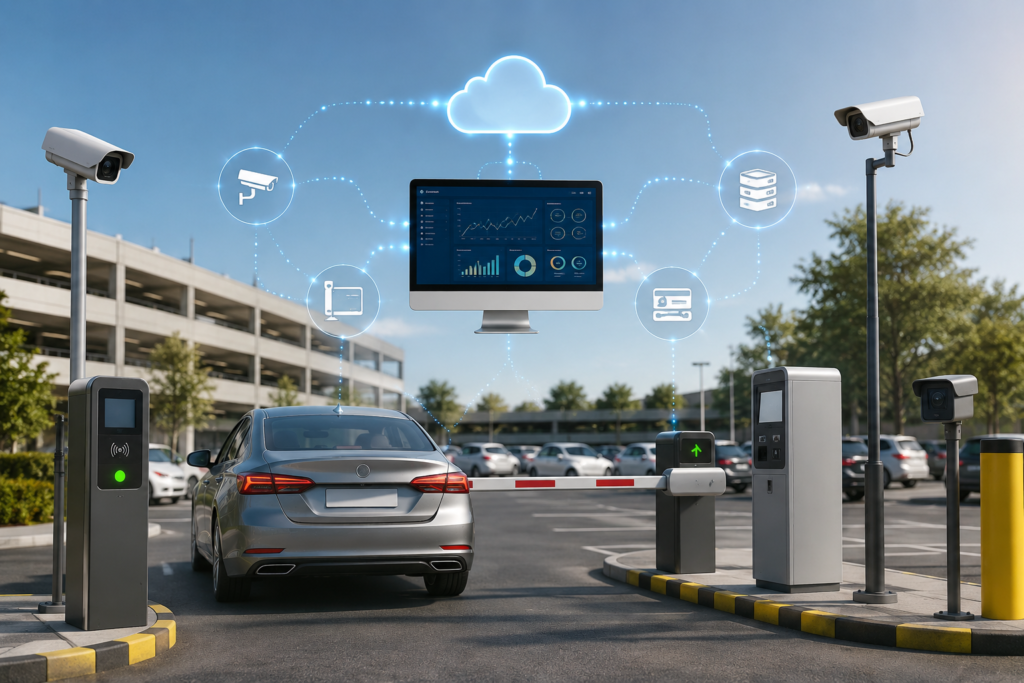
How our team Engineered an Intelligent RFID-Driven Platform Integrating IoT, Edge Computing, Distributed Systems, and Operational Intelligence.
Executive Summary
As organizations increasingly invest in smart facilities, connected infrastructure, and digital operations, traditional parking management systems are rapidly evolving into complex operational platforms requiring real-time visibility, automation, security, analytics, and scalability.
Our team was engaged to design and develop a fully centralized smart parking ecosystem capable of managing the complete vehicle lifecycle—from entry authorization through exit processing—while integrating RFID technologies, automated barriers, surveillance systems, payment operations, edge devices, monitoring platforms, and enterprise reporting into a unified operational environment.
The objective extended far beyond automating parking transactions. The vision was to establish a modern smart infrastructure platform capable of orchestrating physical devices, operational workflows, transactional systems, and business intelligence through a single digital command center.
The resulting solution transformed a traditionally fragmented environment into a scalable, intelligent ecosystem powered by distributed computing, real-time communications, IoT-enabled devices, centralized governance, and operational analytics.
Rethinking Parking as a Digital Operating Platform
For many organizations, parking infrastructure remains a collection of disconnected technologies—access control systems, payment terminals, surveillance equipment, RFID readers, monitoring tools, and reporting applications operating independently.
While functional, these environments often create significant operational challenges:
- Limited visibility into real-time activities
- Manual intervention during operational exceptions
- Fragmented reporting environments
- Difficult integration between hardware and software systems
- Limited scalability as infrastructure expands
- Inconsistent user experiences
- Increased maintenance and support complexity
Modern enterprises require far more.
Parking operations increasingly influence customer experience, security, operational efficiency, asset utilization, revenue collection, and facility management. What was once viewed as an isolated operational function now serves as a critical component of broader smart infrastructure initiatives.
The client sought to replace fragmented processes with a unified platform capable of providing centralized control, real-time monitoring, operational intelligence, and seamless device orchestration across the entire parking ecosystem.
Strategic Objectives
The solution was designed to support several strategic business goals:
| Objective | Desired Outcome |
|---|---|
| Centralized Operations | Unified management of vehicle processing from entry through exit |
| Real-Time Visibility | Immediate insight into operational activity and infrastructure status |
| Intelligent Automation | Minimized manual intervention and operational overhead |
| Device Integration | Seamless coordination among multiple hardware systems |
| Scalability | Support future expansion without architectural redesign |
| Reliability | Continuous operation across distributed environments |
| Operational Intelligence | Actionable reporting and analytics for informed decision-making |
Engineering a Distributed Smart Infrastructure Ecosystem
A key challenge involved coordinating numerous independent devices operating simultaneously throughout the facility.
Each component generated independent operational events requiring validation, synchronization, processing, and monitoring in real time.
Rather than treating these technologies as separate systems, SBSoftTech engineered a distributed infrastructure architecture that unified all components within a centralized operational framework.
The result was a platform where every transaction, vehicle movement, authentication event, and operational status update became part of a coordinated digital ecosystem.
| The Environment Included |
|---|
|
Architecture Overview
The solution was designed using a layered architecture model that separated operational concerns while enabling seamless communication across the environment.
| Architecture Layer | Core Responsibility |
|---|---|
| Device Layer | RFID readers, cameras, barriers, displays, printers |
| Edge Processing Layer | Local device orchestration and event processing |
| Integration Layer | Service communication and synchronization |
| Business Logic Layer | Vehicle management, access control, transactions |
| Data Layer | Centralized storage and reporting |
| Analytics Layer | Monitoring, dashboards, operational intelligence |
| Administration Layer | Configuration, management, governance |
This architecture enabled the platform to maintain centralized control while distributing operational processing closer to the physical devices themselves.
Leveraging Edge Computing for Real-Time Operations
One of the most important design decisions involved adopting an edge-computing model using devices such as Raspberry Pi and oDroid controllers.
Instead of forcing all device communications through a centralized processing layer, local intelligence was strategically deployed at the edge of the network.
This approach delivered several benefits:
- Reduced Latency: Critical operations such as barrier activation and RFID validation could be processed immediately without relying on centralized round-trip communications.
- Improved Reliability: Local processing reduced dependency on continuous connectivity while preserving synchronization with central systems.
- Enhanced Scalability: Additional parking lanes, readers, devices, and monitoring points could be introduced without major architectural changes.
- Operational Resilience: The distributed architecture minimized single points of failure while maintaining centralized visibility and governance.
The result was a system capable of delivering both real-time responsiveness and enterprise-scale manageability.
RFID-Driven Vehicle Identification and Access Management
Vehicle identification formed the foundation of the solution.
The platform incorporated multiple RFID technologies including:
- 13.56 MHz RFID Readers
- 900 MHz UHF RFID Readers
- NFC Readers and Writers
to enable secure vehicle authentication and automated access control.
Every vehicle interaction generated digital events that could be processed, validated, monitored, and analyzed throughout the platform.
This created a highly automated operational model while significantly reducing manual intervention and processing delays.
Real-Time Event Processing and Device Orchestration
Modern infrastructure systems generate thousands of operational events that must be processed with speed and accuracy.
The platform was designed to handle:
- Vehicle entry requests
- Vehicle exit validations
- RFID authentication events
- Payment processing activities
- Device health monitoring
- Barrier activation commands
- Inventory notifications
- Administrative actions
- Security-related events
Communication among devices utilized service-oriented integrations and network communication protocols including TCP/IP and UDP technologies.
This architecture enabled geographically distributed devices to function as a coordinated operational network rather than isolated hardware components.
Enterprise Administration and Operational Governance
A centralized administration environment provided complete visibility into parking operations.
Key operational capabilities included:
- Vehicle Tag Management: Registration and management of authorized vehicle credentials.
- Transaction Monitoring: Real-time visibility into parking activity and operational events.
- POS Operations: Integrated payment processing and transaction management.
- Low-Inventory Notifications: Automated monitoring and alerts for operational consumables.
- Video Monitoring: Integrated visibility into operational activities and infrastructure status.
- Administrative Reporting: Centralized access to operational and performance data.
This administrative framework enabled operators to manage complex infrastructure from a unified control environment.
Security, Reliability, and Data Integrity
Operational infrastructure environments demand both performance and trust.
The platform was engineered with a strong focus on:
- Authentication efficiency
- Data validation
- Transaction integrity
- Controlled device communications
- Operational auditability
- High system availability
Performance optimization ensured:
- Fast processing times
- Reliable RFID accuracy
- Minimal network latency
- Efficient resource utilization
- Strong user experience
- High device uptime
while preserving the security and integrity of operational data.
Transforming Operational Data into Actionable Intelligence
Beyond operational automation, the platform was designed to generate meaningful business intelligence.
Using integrated reporting services, operational leaders gained visibility into:
- Vehicle traffic patterns
- Revenue activity
- Device utilization
- Operational bottlenecks
- System performance metrics
- Transaction trends
- Infrastructure health indicators
The solution leveraged Business Intelligence Reporting Services (RDLC) to support advanced operational reporting and decision-making.
Rather than simply collecting data, the platform transformed operational events into actionable insights that could improve efficiency, planning, and service delivery.
Business Outcomes
The completed platform delivered measurable operational improvements across multiple dimensions.
- Increased Operational Efficiency: Automation reduced manual processing and accelerated vehicle throughput.
- Improved User Experience: Vehicle entry and exit processes became faster, more predictable, and easier to manage.
- Enhanced Infrastructure Visibility: Operations teams gained centralized visibility into devices, transactions, and operational performance.
- Greater Reliability: Distributed processing improved resilience and reduced operational disruption.
- Scalable Architecture: The platform was designed to accommodate growth without requiring significant redesign.
- Stronger Decision Support: Real-time reporting and analytics enabled more informed operational management.
- Seamless Integration: The architecture successfully unified diverse hardware and software systems into a single operational ecosystem.
BEYOND PARKING: A BLUEPRINT FOR SMART INFRASTRUCTURE
While developed for parking operations, the architectural principles behind this solution extend far beyond a single use case.
The same combination of:
- IoT-enabled devices
- Edge computing
- Distributed processing
- Real-time communications
- Operational analytics
- Centralized governance
- Intelligent automation
can be applied across numerous environments including:
- Smart campuses
- Healthcare facilities
- Transportation hubs
- Warehousing operations
- Industrial facilities
- Logistics centers
- Asset-intensive enterprises
As organizations continue investing in digital transformation and connected infrastructure, the ability to orchestrate physical operations through intelligent software platforms will increasingly become a strategic differentiator.
This project demonstrates how operational environments can be transformed into intelligent digital ecosystems capable of delivering automation, visibility, scalability, and actionable business intelligence at enterprise scale.
Technologies Utilized
| RFID & Access Technologies |
|---|
|
| Edge & Embedded Systems |
|---|
|
| Application Development |
|---|
|
| Data & Reporting |
|---|
|
| Networking & Communications |
|---|
|
| Infrastructure |
|---|
|