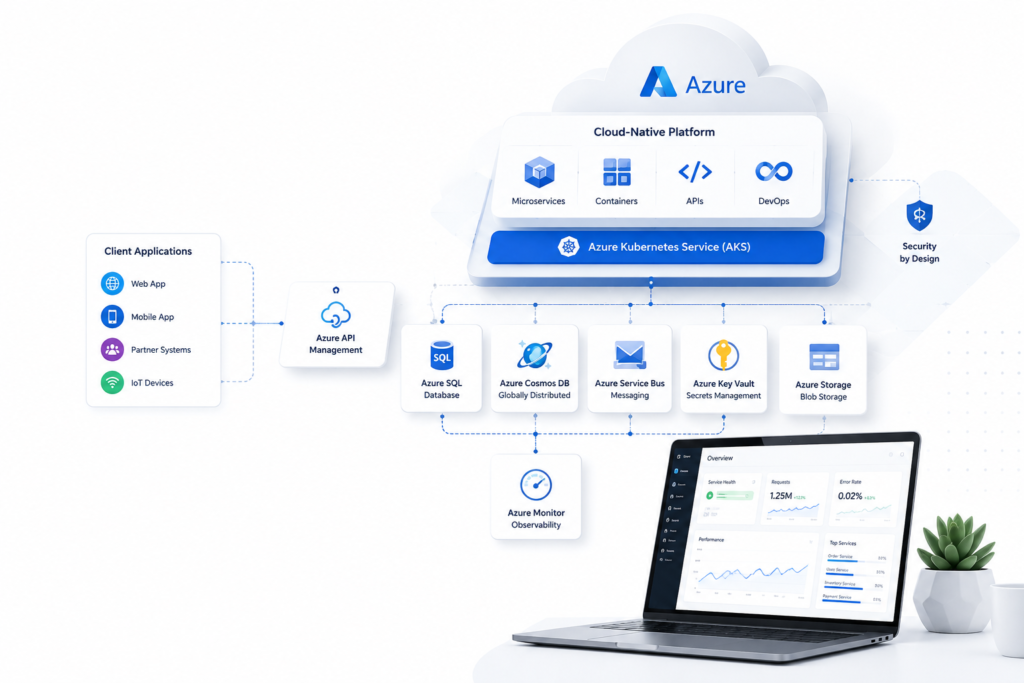
How Our Team Helped Organizations Modernize Legacy Applications into Scalable, Secure, Cloud-Native Digital Platforms Using Microsoft Azure.
Executive Summary
Cloud computing has fundamentally changed the way modern enterprises design, deploy, and evolve business applications. Today’s organizations require far more than hosted infrastructure—they need intelligent, cloud-native platforms capable of supporting continuous innovation, seamless integration, enterprise security, operational resilience, and elastic scalability.
Across multiple modernization initiatives, our engineering team partnered with organizations to transform legacy business applications into modern, cloud-native enterprise platforms built on Microsoft Azure. Rather than simply migrating workloads to the cloud, we reimagined application architecture to leverage platform services, event-driven processing, automated deployments, API-first integration, and cloud-native operational practices.
The resulting platforms enabled organizations to improve scalability, accelerate software delivery, strengthen security, reduce operational complexity, and establish a flexible technology foundation capable of supporting long-term business growth.
Beyond Cloud Migration: Rethinking Enterprise Applications
Many organizations begin their cloud journey by relocating existing applications from on-premises infrastructure into virtual machines hosted in the cloud.
While infrastructure migration provides immediate operational benefits, it rarely unlocks the full value of cloud computing.
Traditional enterprise applications often continue to experience:
- Limited scalability during peak demand
- Monolithic architectures that slow innovation
- Manual deployment and release processes
- Complex integration between enterprise systems
- Limited operational visibility
- Infrastructure management overhead
- Increasing maintenance costs
- Security and compliance challenges
- Difficulty introducing new digital capabilities
The challenge presented to our engineering team was not simply to “move applications to Azure”.
It was to redesign critical business systems into cloud-native enterprise platforms capable of supporting continuous delivery, intelligent automation, enterprise integration, and future innovation.
Strategic Objectives
| Objective | Desired Outcome |
|---|---|
| Cloud Modernization | Transition legacy applications to cloud-native architecture |
| Enterprise Scalability | Automatically adapt to changing business demand |
| Operational Resilience | Improve availability, fault tolerance, and disaster recovery |
| Continuous Delivery | Accelerate releases through automated DevOps pipelines |
| Enterprise Integration | Enable seamless connectivity across internal and external systems |
| Security & Governance | Strengthen identity management, compliance, and operational governance |
| Future Readiness | Build a platform capable of supporting ongoing innovation |
Engineering Cloud-Native Enterprise Platforms
Cloud-native engineering requires far more than infrastructure provisioning.
Every platform was designed around a set of architectural principles that prioritized flexibility, modularity, resilience, and long-term maintainability.
Instead of developing tightly coupled monolithic applications, our engineering team adopted a service-oriented architecture where business capabilities could evolve independently while remaining securely integrated.
The resulting platforms provided organizations with a modern digital foundation capable of supporting business growth while reducing operational complexity.
Cloud Architecture Overview
| Platform Layer | Primary Responsibility |
|---|---|
| Presentation Layer | Responsive web and mobile user experiences |
| Application Services | Business logic hosted through Azure App Services |
| Serverless Layer | Event-driven processing using Azure Functions |
| Integration Layer | API Management, REST APIs, Azure Service Bus |
| Identity Layer | Azure Active Directory and secure authentication |
| Data Layer | Azure SQL Database, Azure Storage |
| Monitoring Layer | Azure Monitor, Application Insights |
| DevOps Layer | Azure DevOps, CI/CD, Infrastructure Automation |
This layered architecture enabled individual components to scale independently while maintaining centralized governance and operational visibility.
Leveraging Microsoft Azure as a Strategic Platform
Rather than using Azure simply as cloud infrastructure, we utilized Microsoft’s Platform-as-a-Service (PaaS) ecosystem to maximize agility, resilience, and operational efficiency.
Key platform capabilities included:
- Azure App Services: Hosting enterprise-grade applications with built-in scalability, availability, and simplified operations.
- Azure Functions: Supporting serverless workloads, background processing, event-driven automation, and asynchronous business processes.
- Azure Service Bus: Providing reliable messaging and decoupled communication between enterprise services.
- Azure SQL Database: Delivering managed relational databases with high availability, automated backups, and enterprise-grade performance.
- Azure Active Directory: Centralizing authentication, identity management, and secure access across distributed applications.
- Azure API Management: Exposing secure APIs that simplified enterprise integration while enabling future extensibility.
Engineering Continuous Delivery
Successful cloud platforms require an equally modern software delivery lifecycle.
Our engineering practices incorporated Azure DevOps to automate:
- Source code management
- Build validation
- Continuous Integration (CI)
- Automated testing
- Continuous Deployment (CD)
- Release approvals
- Environment promotion
- Infrastructure provisioning
These practices reduced deployment risk while enabling organizations to deliver new capabilities more frequently and with greater confidence.
Enterprise Integration & API-First Design
Modern enterprise platforms rarely operate in isolation.
The solutions were designed to integrate seamlessly with ERP platforms, CRM systems, payment gateways, identity providers, third-party SaaS applications, and custom enterprise systems.
By embracing API-first principles and event-driven communication, organizations gained:
- Faster integration cycles
- Reduced system dependencies
- Improved interoperability
- Greater architectural flexibility
- Easier future expansion
Security, Governance & Operational Excellence
Enterprise cloud platforms must balance agility with governance.
Security was embedded throughout the platform lifecycle through:
- Azure Active Directory authentication
- Role-Based Access Control (RBAC)
- Secure API authorization
- Data encryption
- Secrets management
- Centralized monitoring
- Audit logging
- Continuous operational visibility
These practices strengthened enterprise security while supporting compliance and governance objectives.
Transforming Operational Data into Actionable Intelligence
Cloud-native platforms generate rich operational telemetry.
Using Azure Monitor and Application Insights, organizations gained visibility into:
- Application performance
- User behavior
- Resource utilization
- System availability
- API performance
- Error diagnostics
- Infrastructure health
- Capacity planning
This operational intelligence enabled engineering teams to continuously optimize platform performance while supporting proactive decision-making.
Business Outcomes
The modernization initiatives delivered measurable value across multiple dimensions.
| Business Outcome | Business Impact |
|---|---|
| Cloud Scalability | Applications automatically adapted to changing demand |
| Faster Delivery | CI/CD significantly reduced release cycles |
| Improved Reliability | Highly available cloud architecture minimized downtime |
| Enhanced Security | Identity, governance, and monitoring strengthened enterprise protection |
| Reduced Operational Overhead | Managed Azure services simplified infrastructure operations |
| Better Integration | API-first architecture accelerated enterprise connectivity |
| Future-Ready Platform | Modern architecture supported ongoing innovation and digital transformation |
Beyond Azure: Building Digital Platforms for Continuous Innovation
Cloud adoption should never be viewed as an infrastructure project.
Its true value lies in enabling organizations to rethink how enterprise systems are designed, integrated, operated, and continuously improved.
By combining cloud-native architecture, platform engineering, DevOps automation, API-first integration, event-driven processing, and enterprise governance, organizations establish a digital foundation capable of evolving alongside business strategy rather than limiting it.
This project demonstrates how modern cloud platforms can become strategic business assets—enabling greater agility, resilience, scalability, and innovation while preparing organizations for the next generation of intelligent enterprise applications.
Technologies Utilized
| Microsoft Azure Services |
|---|
|
| Development Technologies |
|---|
|
| DevOps & Automation |
|---|
|
| Integration Technologies |
|---|
|
Key Takeaways
Cloud modernization is most successful when organizations move beyond infrastructure migration and embrace cloud-native engineering principles. By leveraging Microsoft Azure’s platform services, adopting API-first architectures, automating software delivery, and embedding security and observability into every layer of the solution, organizations can transform traditional business applications into resilient, scalable, and future-ready digital platforms.
This case study reflects our approach to enterprise cloud engineering—combining strategic architecture, modern development practices, and operational excellence to deliver platforms that accelerate innovation and create lasting business value.